2nd Battle of Kernstown
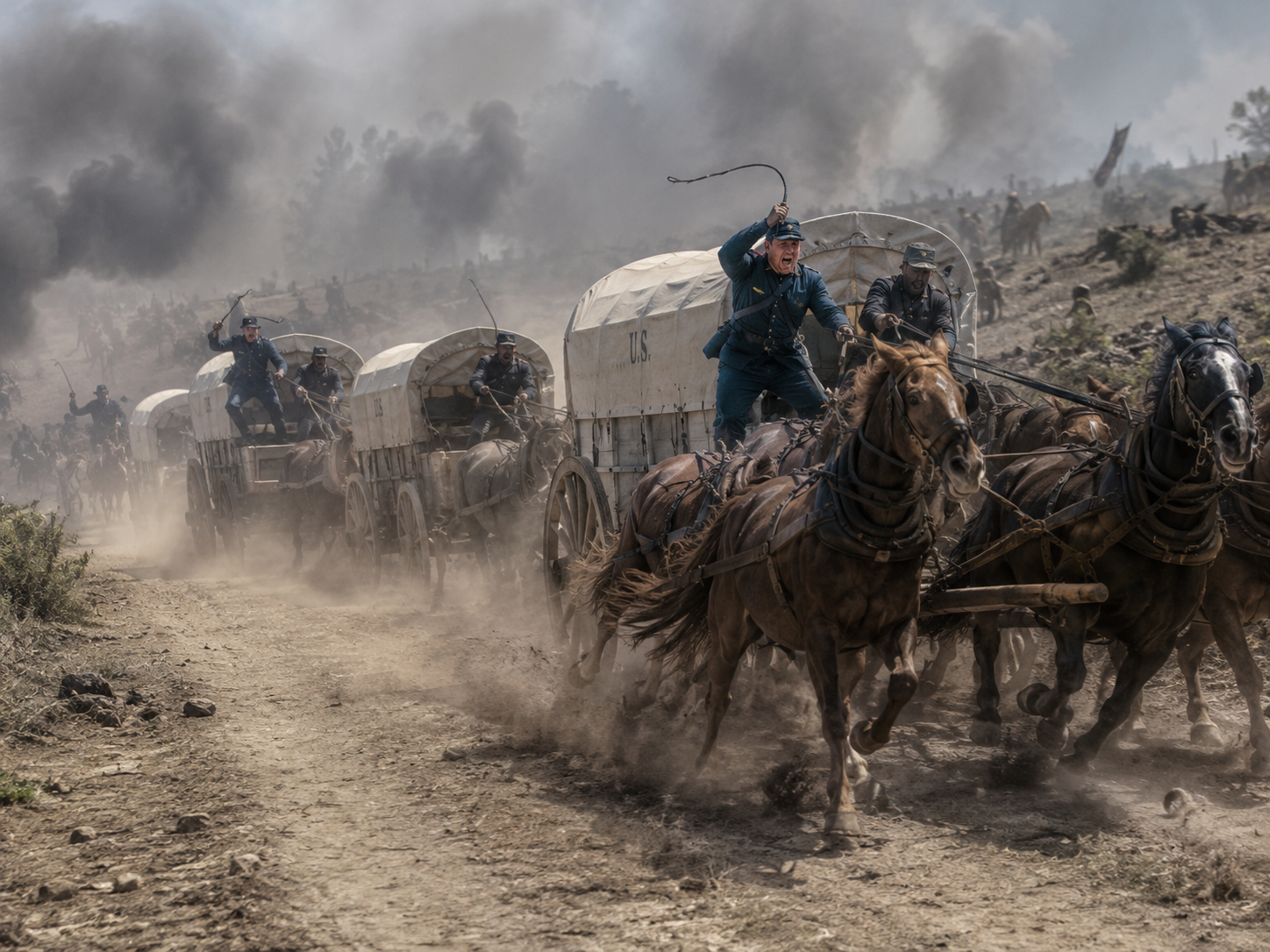
Second Battle of Kernstown — July 24, 1864
The Second Battle of Kernstown was fought on July 24, 1864, at Kernstown, Virginia, outside Winchester, Virginia, as part of the Valley Campaigns of 1864 in the American Civil War. The Confederate Army of the Valley under Lt. Gen. Jubal A. Early soundly defeated the Union Army of West Virginia under Brig. Gen. George Crook and drove it from the Shenandoah Valley back over the Potomac River into Maryland.
As a result, Early was able to launch the Confederacy's last major raid into northern territory, attacking the Baltimore and Ohio Railroad in Maryland and West Virginia and burning Chambersburg, Pennsylvania, in retaliation for the burning of civilian houses and farms earlier in the campaign. Crook retreated to the Potomac River and crossed near Williamsport, Maryland on July 26. Because of this defeat and the subsequent burning of Chambersburg on July 30, Grant ordered the VI and XIX Corps back to the Shenandoah Valley and unified several Federal commands in the region under Gen. Philip Sheridan.
The later Union burning of major sections of the Shenandoah, in some Union minds, was retribution for the Chambersburg burning.
22nd Pa Joins General Averill's Division
What is interesting about this Order of Battle is that the 22nd Pa is part of the First Division Second Brigade. In other battles they were part of the Second Division First Brigade.
Also, this is a rare case where the maps made to explain the battle to modern day visitors include the 22nd Pennsylvania specifically and not just the name of the commanding officer; in this case Col. Higgins.
Although the battle resulted in the Union forces being pushed all the way back across the Potomac and allowed the rebels to cross into Maryland, there was a significant part played by portions of the 22nd Pennsylvania. One story is the story of Captain James P. Hart's charge against vastly superior rebel forces.

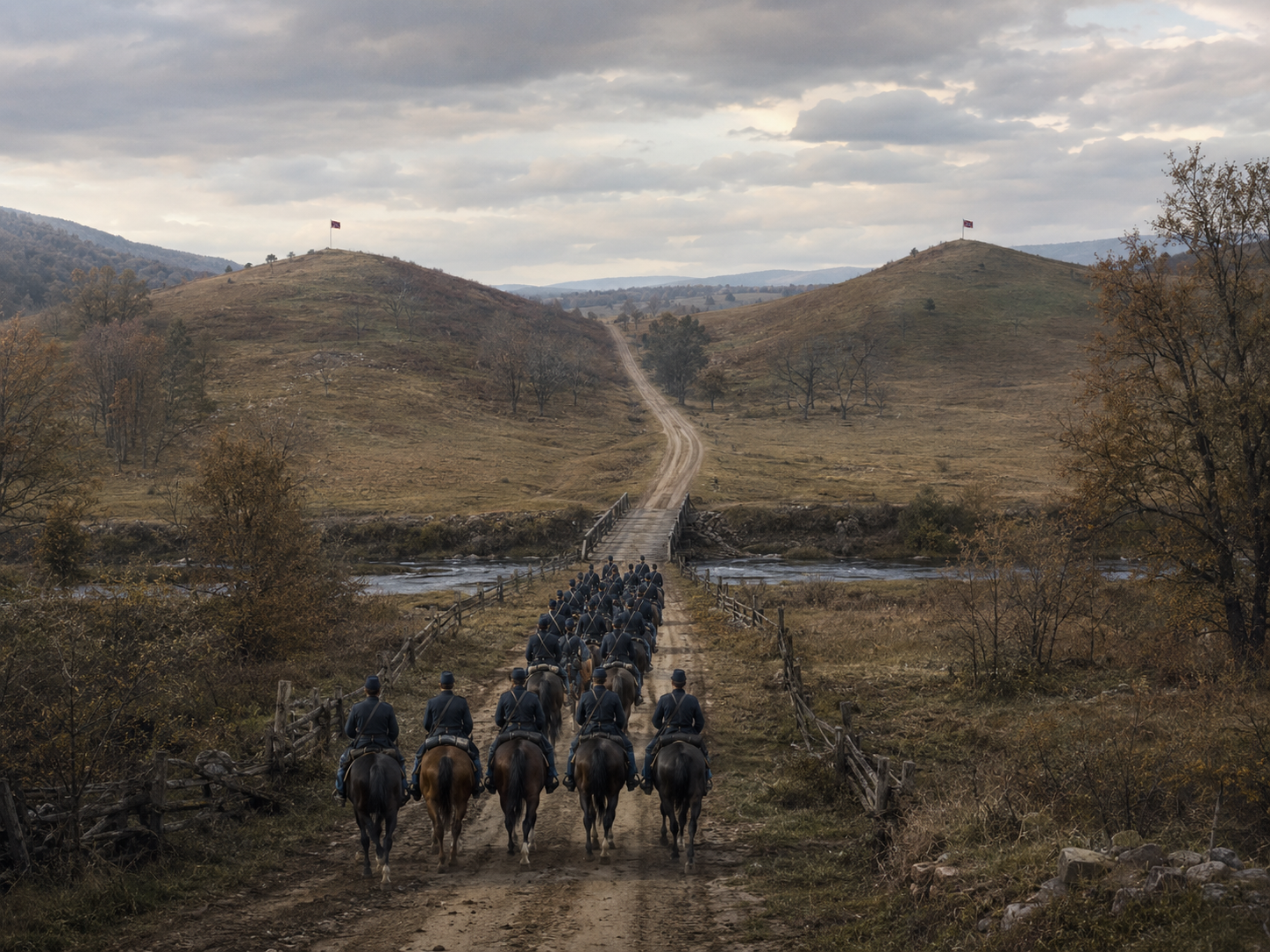
Captain Hart's Charge
From the unit diaries we learn: On July 22, 1864 the unit reached Milltown 2 miles above Winchester. After dark part of the Regiment was ordered on duty and remained out the front on the skirmish line all night. Next morning the remainder of the battalion available for duty, moved out to the left of the pike and halted near Kernstown. General Duffee in command of the cavalry division had the impression that the enemy's battery on a ridge about in my own front of us was not supported and he directed Major Work to make an investigation to determine if this was true.
Capt. James P Hart was ordered to take a detail of 50 to 60 carbineers from his command and charge the battery but to wait for a signal after passing through Kernstown, as the other two columns with us would then move simultaneously but some distance from us. The order for the charge was given by the general although it was denounced at the time by several officers, all declaring that if it was made, not a man would come out alive. Col. Allen of the first New York veteran cavalry protested to the General pointing out to him the position and number of enemy and saying to him, you can't take the battery out with your whole division. Col. Allen told Capt. Hart he would be justified in refusing to obey the order.
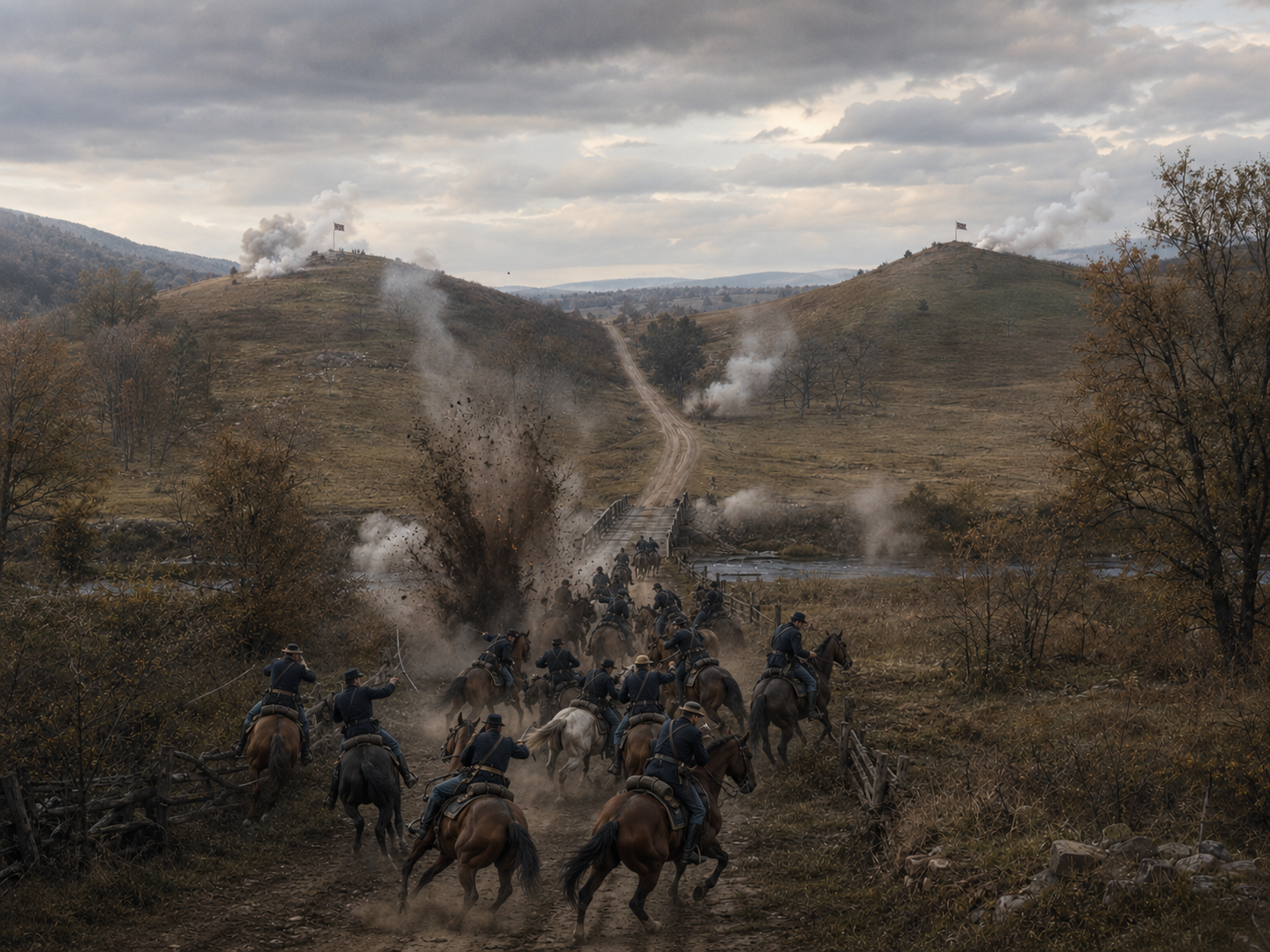
Soon the report of a cannon set our columns in motion. Our column moving briskly with the precision of a parade marching in columns of fours until we reach the brow of the hill, when we formed double line and charged down the pike. At the foot of the hill was a ravine into which flowed a stream, wide and deep. This washout was spanned by an ordinary wagon bridge wide enough only for four abreast to cross. The enemy, knowing that our formation would have to be broken here in order to cross the bridge, withheld fire until we reach this point. Then their battery opened up on us with grape shot and canister, but fortunately for us the guns were on a bluff so high above us, they could not depress them sufficiently to hit us.
Just then a body of their infantry behind the stone fence open with musket fire upon us. Capt. Hart saw that the way to save our little band from annihilation was our charging into the wash. We did that, and it was deep enough to almost cover horse and rider. We had to move to the left some distance before we could get back out. The air over our heads was full of grapeshot canister and mini balls. Our situation was extremely perilous. The only thing to do was to get out of there as soon as possible, so we fell back rapidly keeping to the left of the pike and up to find help while still under artillery fire and still for a time in range of the enemy's muskets. A body of the enemy cavalry now charged us fiercely. Several of our men had been unhorsed and were now in imminent danger of being captured. Capt. Hart, seeing their peril, rallied his horsemen, held the enemy in check.
The men on foot ran several hundred yards up the hill and got to a strip of timber. These rallies and charges were repeated several times until our men were out of danger and the enemy fell back. John Regester of our company was mortally wounded, and his horse killed by a shell passing through the timber on our retreat.
Our Trip to Kernstown — August 2018
On Sunday August 5, 2018 Camille and I went to the Kernstown Battlefield to meet with Susan Golden, V.P. of the Kernstown Battlefield Association. I had communicated with her over the past couple of weeks about trying to find the exact place where the charge of James P. Hart and the 22nd Pa had taken place. At first, she was not aware of the story, but she assigned two of her docents to research the question and within a week she told me she would have a surprise for me when I visited.
At arrival Camille and I were greeted warmly by Susan and two docents: Larry Turner and Mike Cannane. After a short chat, Larry and Mike loaded us into Larry's car and off we went in search of Civil War history. Scott Patchen is a well-known historian who has written much about the Shenandoah Valley, the battles, and the details. In his book Scott Patchen describes the exact cavalry action that I had found. He had added materials like the fact that Captain James P. Hart had the nickname Biddy and also the probable location for the action.
Tracing the Valley Pike
Our first stop was a bank parking lot just off but abutting highway 11 which is the valley pike. In the stories it is referred to as the pike, the turnpike, and in one case the Staunton Pike. In July 1864 it was the main north-south route in the valley and was made of broken rock packed deep — a process that yields a road referred to as macadamized. This bank parking lot is located where the 22nd Pa cavalry camped on the night of July 22nd; the day before the battle.
From this location we moved south on the pike not very far to a pizza parlor parking lot. This was the location where the main body of the 22nd stopped and remained on the morning of the battle. They would have been just east of the road with their right end at the road and their left end in a field that is no longer there. It is from this location that the scouting mission that became Hart's charge was launched.
The Opequon Creek Crossing
We then moved south again on the pike. Of course, everything is built up now and the topography is hard to determine just driving down the road in traffic. Streams have been diverted or bridged. Some hills have been topped and some low areas filled in. To make matters worse the major interstate, Highway 81, runs just a short way off.
The first potential location was at the current overpass of Highway above Route 11. There is a long hill down to the overpass but all the highway work would have obliterated the wash or ravine mentioned in the story. Also there is no real hill where the cannon battery would have been located.
The second location, preferred by Mike Cannane, was at the Opequon Creek crossing near 4273 Valley Pike. There is a good long hill down to the crossing, there would have been a small bridge there, and across the creek is a sizable hill. The story from the unit diary says, at the foot of the hill was a ravine into which flowed a stream, wide and deep. The first location showed no signs of a stream wide and deep; but this location did exactly that. The only issue is that the Hite House stands right there off the road. It has been there since the 1700s which makes it hard to imagine why the story about the 22nd did not mention this famous and very large stone home with barns.
Either one of these two places thrilled me. It was obvious that one of them was correct. I might never know which one, but it does not really matter. They are close together and right on the valley pike.
In the map of the battle, the position of the 22nd Pa is shown in the upper right-hand quadrant under the name Duffie. This corresponds to the pizza parlor parking lot which is the ground they held before the general rout and retreat.